What is honeycomb paper packaging? Structure, components and where it is used
Honeycomb paper packaging is built from connected hexagonal paper cells faced with paper sheets. Here is how the structure works, which components it is made into, and where B2B shippers use it.

Hexacell team
7 min read
Short answer: Honeycomb paper packaging is protective packaging made from a core of connected hexagonal paper cells, the same pattern as a bee's honeycomb, bonded between paper facing sheets. The cell structure gives the board good vertical strength for its weight and lets it crush in a controlled way to cushion a product. The boards are then cut, die-cut, layered or folded into components such as pads, corner protectors, edge boards, fillers, pallets and crates.
This guide explains how the material is built, what it is made into, and where buyers in manufacturing and export use it.
How honeycomb paper is built
A honeycomb board has three layers:
- The core: strips of paper bonded so that, when expanded, they form a sheet of connected hexagonal cells. Each cell shares its walls with its neighbours.
- Two facing sheets (liners): flat paper sheets bonded to the top and bottom of the core, giving the board smooth surfaces that can be cut, printed or laminated.
- Adhesive: used to bond the core strips and to fix the liners. Hexacell's current catalogue describes its products as made from kraft paper and a paste or glue adhesive.
The core on its own is supplied as honeycomb paper core, which panel makers laminate with paper, wood or plastic faces. Packaging users usually need finished boards or components made from them.
Why the hexagon matters
Because every cell wall is shared, a load pressing down on the board is spread across many thin paper walls standing on edge. That is why a light paper board can be stiff and support weight from above. When an impact exceeds what the walls can carry, they fold and crush progressively rather than shattering, and that crushing is what absorbs energy and cushions the product.
What changes the performance
Honeycomb packaging is not one fixed material. Its behaviour depends on the specification, mainly:
- Cell size: smaller cells mean more walls per area.
- Board thickness (core height): thicker boards give more crush distance for cushioning.
- Paper grade: the weight and quality of the core and liner paper.
- How components are combined: a base, corner posts and edge boards work together as one pack.
Published research supports this. An experimental study in Packaging Technology and Science (Wang and Wang, 2008) found that the relative density of the honeycomb core had a significant effect on cushioning, that boards with liners cushioned significantly better than core without liners, and that board height affected cushioning performance. The same study found that multilayer boards do not always absorb more energy than a single layer. In other words, the right configuration has to be designed for each product, not assumed.
This is why Hexacell does not publish a single load rating. Performance is specified and checked against your product, its weight and its journey.
The main honeycomb packaging components
Hexacell groups its range into three families.
Materials and boards
- Honeycomb paper core: the cellular layer itself, used inside panels and boards.
- Boards, separators and partitions: flat boards used as layer pads, dividers and partitions that keep parts in position and apart inside a box or on a pallet.
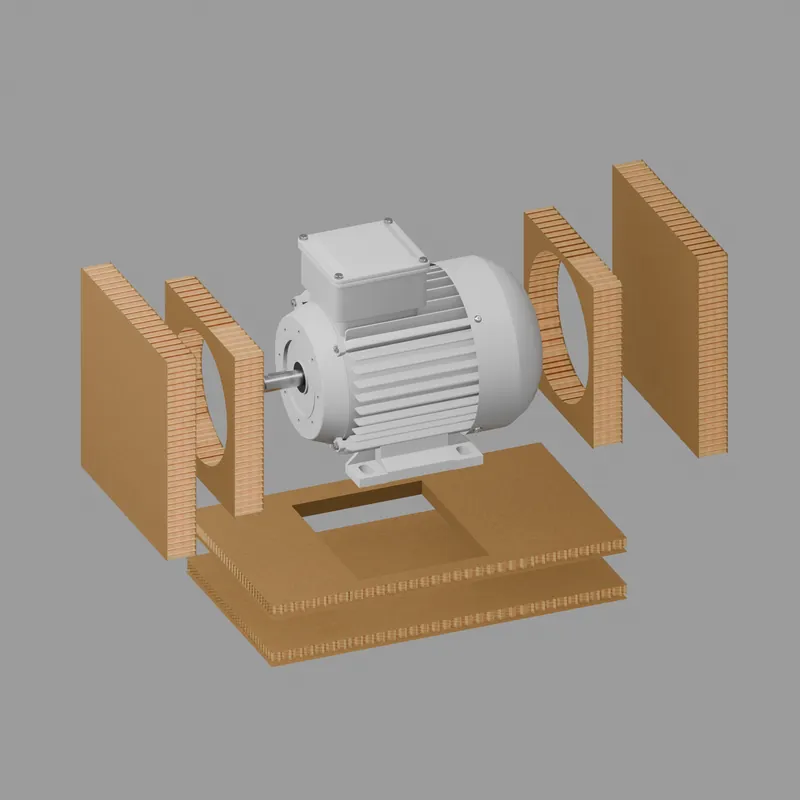
- Die-cut honeycomb boards: boards cut to follow the shape of a product, for example with circular cut-outs that hold rolls or cylindrical parts in layers. They are often discussed as a paper alternative to die-punched plastic or wooden sheets.
Protective components
- Corner protectors: shaped pieces for exposed corners and edges, typically used on all four corners of a pack, where they also add vertical support for stacking.
- Fillers, buffers and spacers: pieces that fill voids and limit movement inside a carton. They can be made more rigid or more cushioning depending on the product and transport mode.
- Angle and edge boards: L, U and C profiles run along the edges of a load to protect edges and help a pallet load travel as one stable unit.
Transport packaging
- Paper pallets: pallets with a honeycomb board deck and paper feet or blocks, free from nails and splinters, sized to the load.
- Paper crates and pallet boxes: enclosures that combine honeycomb board, corrugated board and angle board, discussed as an alternative to wooden and plastic crates.
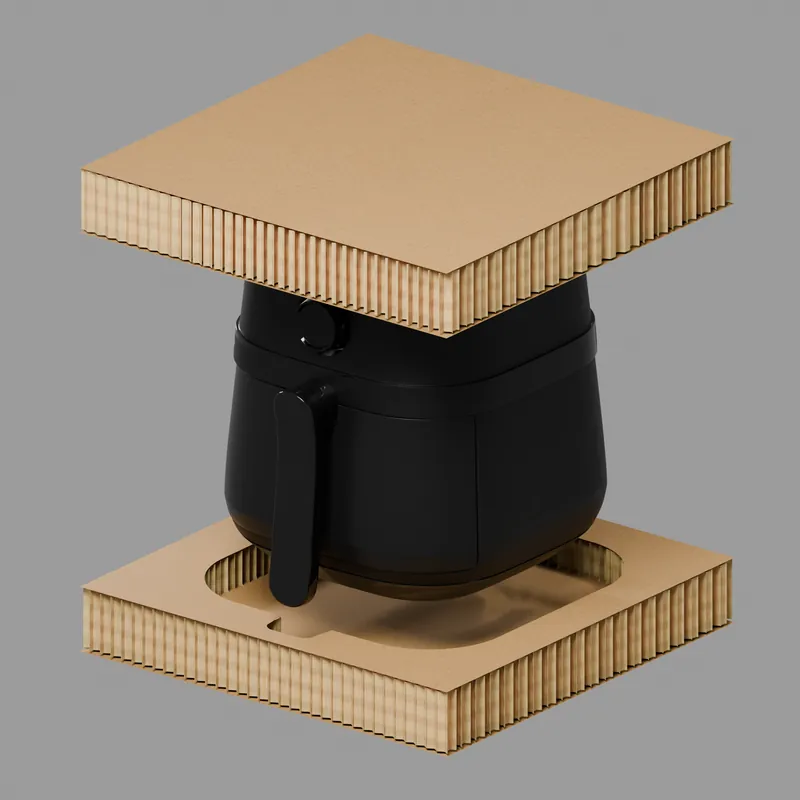
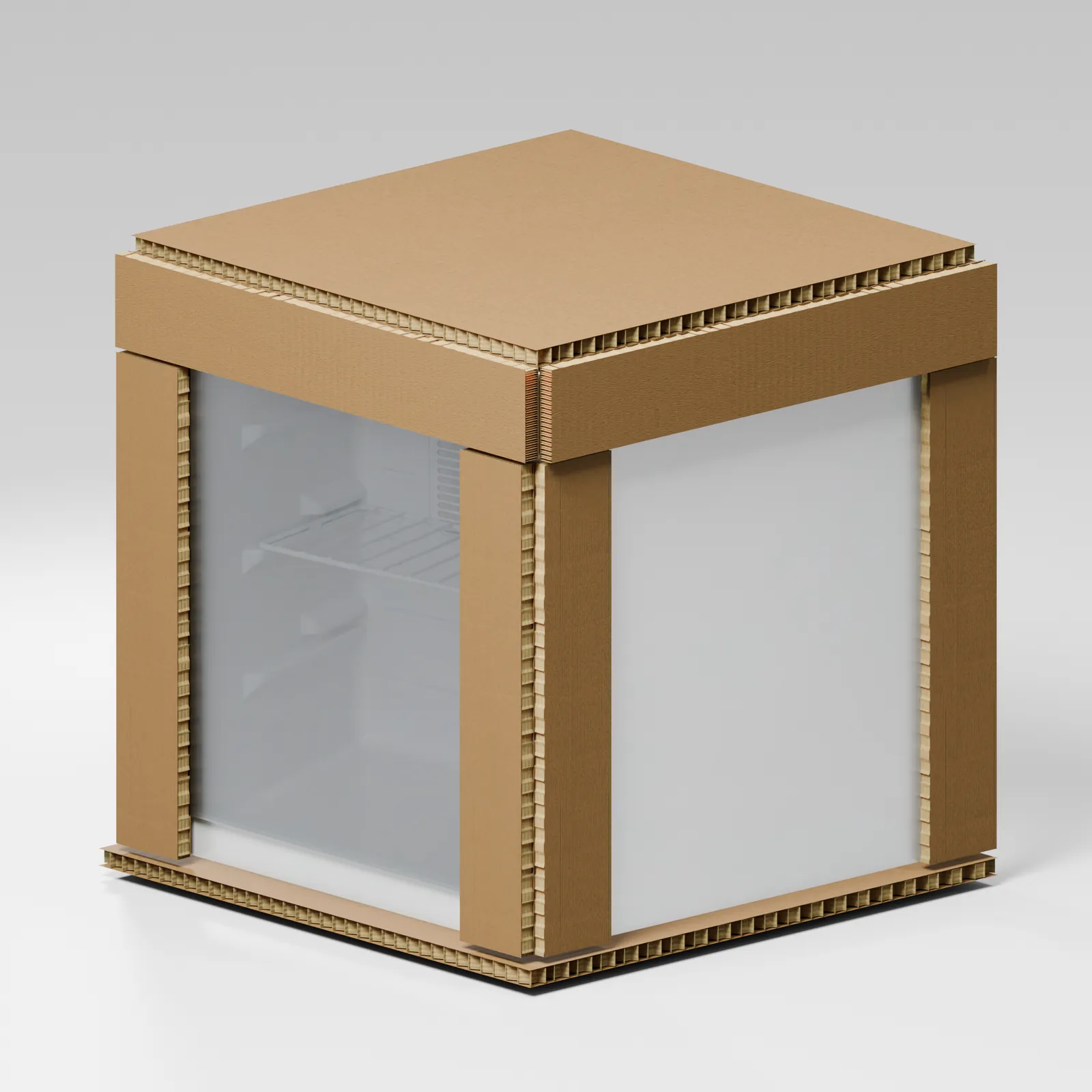
Most real packs combine several of these. An appliance might sit on a shaped base, with corner posts, side panels and a top cap inside its outer carton.
Where honeycomb paper packaging is used
Typical applications include:
- Home appliances and electronics: refrigerators, microwaves, air conditioners, TVs and small kitchen appliances, where large painted or glass surfaces, controls and corners need protecting inside a carton.
- Industrial equipment and goods: motors, panels, bottles and bulk goods such as yarn or drums, using enclosures, bases, layer boards and edge components.
- Automotive parts: trays, partitions and shaped cradles that keep parts like brake discs or silencers separated and located.
- Furniture and interior panels: honeycomb core used as the light inner structure of table tops, shelving and door panels.
Why buyers consider it
Buyers usually look at honeycomb paper for a mix of practical and material reasons:
- Paper-based packaging. Hexacell positions its components as a substitute for wood, thermocol (EPS), Styrofoam and other plastic packaging. Keeping the whole pack paper-based can simplify the material mix your customer has to deal with.
- Light for its stiffness. The cell structure gives rigidity without solid infill.
- No nails or splinters. Smooth paper surfaces are kinder to product finishes and to people handling the pack.
- Made to size. Boards and components are cut to your product's dimensions rather than relying on moulds.
- Flat supply. Many components can be supplied flat, which helps where storage space is tight.
- Export paperwork. The international standard for wood packaging, ISPM 15, covers wood packaging material made from raw wood. Paper pallets contain no solid wood, but you should always confirm the import rules of the destination country.
Limits to plan for
Honeycomb paper is still paper. Long exposure to water or high humidity, for example on sea freight or in outdoor storage, has to be considered at the design stage, and water-resistant options can be discussed. Recyclability depends on the paper, adhesives, any coatings and the facilities where the pack ends up. If you need documented recyclability or material declarations, ask for them in your brief.
Frequently asked questions
Is honeycomb paper the same as corrugated board?
No. Both are paper-based, but corrugated board uses wavy fluted paper between liners, while honeycomb board uses a core of connected hexagonal cells standing on edge. Honeycomb gives a flat, rigid panel that is often used where vertical support and thicker cushioning are needed. The right choice depends on the load and handling.
Can honeycomb paper packaging carry heavy products?
It can, but strength depends on cell size, board thickness, paper grade and how components are combined. There is no single load rating that fits every product. Share your product's weight, stacking and shipping conditions so a suitable configuration can be designed, prototyped and tested.
Is honeycomb paper packaging waterproof?
Standard paper honeycomb is not waterproof. If your shipment faces humidity, condensation or wet storage, mention it at the start so moisture-resistant options can be discussed and checked for your route.
How do I start a honeycomb packaging project?
Share what you need to pack, its dimensions and weight, its fragile areas, and how it is handled, stored and shipped. Our guide to briefing a custom packaging requirement lists what to include, or go straight to custom packaging and share your requirements.
Sources
- Wang, D.-M. and Wang, Z.-W. (2008). "Experimental investigation into the cushioning properties of honeycomb paperboard." Packaging Technology and Science. https://onlinelibrary.wiley.com/doi/10.1002/pts.808
- International Plant Protection Convention. ISPM 15: Regulation of wood packaging material in international trade. https://www.ippc.int/en/publications/640/